

A tornado is a rapidly rotating column of air that extends from a thunderstorm to the ground. Tornadoes are among the most intense and destructive weather events on Earth, capable of producing extremely strong winds, damaging hail, flying debris, and sudden changes in weather conditions. They can form quickly, sometimes with little warning, which is why understanding how tornadoes develop and how to stay safe is so important.
In this guide, we explain what a tornado is, how tornadoes form, the main tornado types, what causes tornado damage, and the most important tornado safety tips to know.
What Is a Tornado?
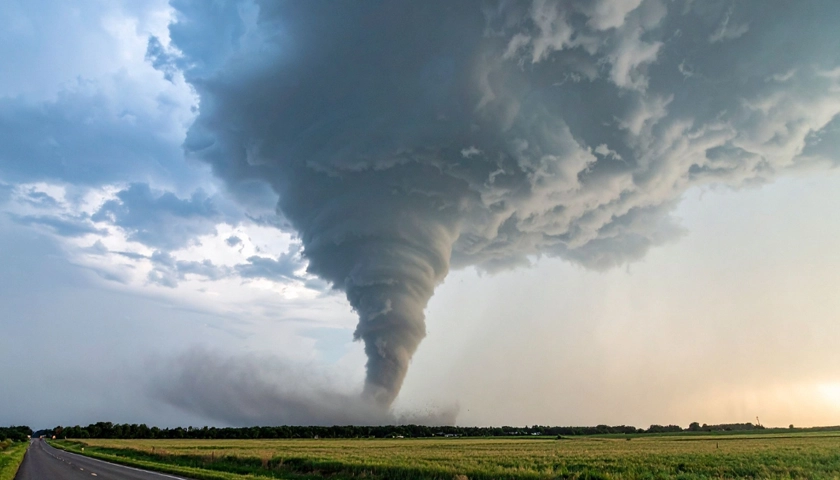
A tornado is a violently rotating column of air connected to both the base of a thunderstorm and the ground. Most tornadoes develop from severe thunderstorms, especially supercells, which are powerful storms with a rotating updraft known as a mesocyclone.
Tornadoes vary in size, strength, and duration. Some are narrow and short-lived, while others can become large, long-track tornadoes that remain on the ground for many miles. Even weak tornadoes can be dangerous because they can throw debris, damage buildings, uproot trees, and disrupt transportation and infrastructure.
How Does a Tornado Form?
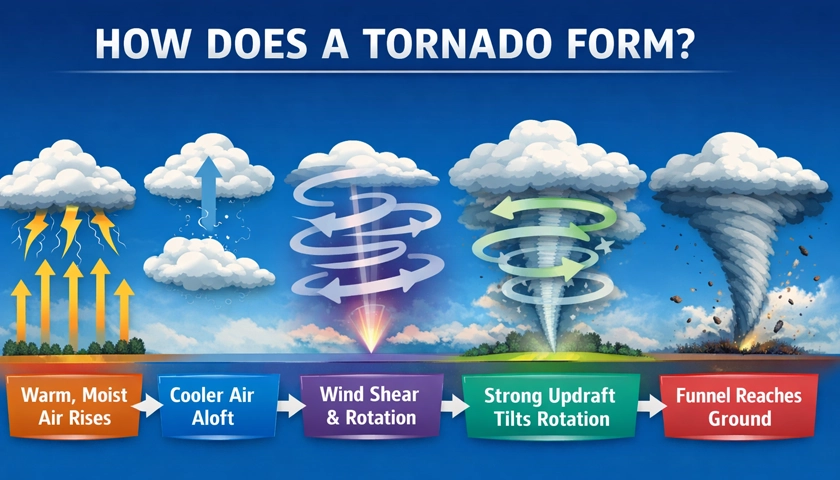
Tornado formation usually requires a specific combination of atmospheric ingredients. These include warm, moist air near the ground, cooler and drier air above, atmospheric instability, and wind shear, which means winds change speed or direction with height.
Here is the basic process:
- Warm, moist air rises into a thunderstorm.
- Cooler air aloft increases instability and helps the storm grow stronger.
- Wind shear causes the air to begin rotating horizontally.
- Strong updrafts tilt that rotation into a vertical position.
- A rotating storm structure develops and may tighten into a tornado.
- The funnel extends downward and, once it reaches the ground, it is considered a tornado.
Not every severe thunderstorm produces a tornado, but the strongest tornadoes are often linked to highly organized storm systems.
What Causes Tornadoes?
Tornadoes are caused by intense atmospheric instability and rotation within severe thunderstorms. The most common causes and contributing factors include:
- Warm, humid surface air that fuels thunderstorm development
- Cold, dry air above that enhances instability
- Strong wind shear that supports storm rotation
- Powerful updrafts that organize and intensify the storm
- Thunderstorm interactions with fronts, drylines, or low-pressure systems
Tornadoes are most frequently associated with supercell thunderstorms, but they can also develop in squall lines, landfalling tropical systems, and other strong convective storms.
Types of Tornadoes
There are several types of tornadoes, and they do not all look the same. The most common types include:
Supercell Tornado
This is the classic tornado type associated with rotating supercell thunderstorms. These tornadoes are often the strongest and can cause the greatest damage.
Landspout
A landspout forms from the ground upward and is usually not associated with a mesocyclone. It is often weaker than a supercell tornado but can still be hazardous.
Waterspout
A waterspout is a tornado or tornado-like rotating column of air that forms over water. Some waterspouts remain weak, but others can become dangerous if they move onshore.
Multiple-Vortex Tornado
This type contains two or more small vortices rotating around a common center. Multiple-vortex tornadoes can produce highly uneven damage patterns.
How Strong Can a Tornado Be?
Tornado strength is commonly rated using the Enhanced Fujita Scale (EF Scale), which estimates tornado intensity based on observed damage. The scale ranges from EF0 to EF5.
- EF0: Light damage
- EF1: Moderate damage
- EF2: Considerable damage
- EF3: Severe damage
- EF4: Devastating damage
- EF5: Incredible damage
The strongest tornadoes can destroy well-built homes, toss vehicles, strip trees, and cause widespread infrastructure failure. However, even weaker tornadoes can be life-threatening, especially in mobile homes, vehicles, and exposed outdoor areas.
Where Do Tornadoes Happen Most Often?
Tornadoes can happen in many parts of the world, but they are especially common in the United States. The central U.S. is known for frequent tornado activity because it often brings together warm, moist Gulf air and colder, drier air from the north and west.
Areas with frequent tornado activity are often discussed in relation to Tornado Alley, though tornadoes are not limited to one region. They can also occur across the Southeast, Midwest, Plains, and even in coastal areas during tropical weather events.
When Is Tornado Season?
Tornadoes can occur at any time of year, but peak tornado season depends on the region. In the central Plains, tornado activity often peaks in spring and early summer. In the southeastern United States, tornadoes can be common in both spring and late fall.
That said, tornadoes can happen during the day or night, and nighttime tornadoes are especially dangerous because they may be harder to see and react to quickly.
What Does a Tornado Look Like?
A tornado may appear as a visible funnel cloud, a narrow rope, a wide wedge, or even a rotating debris cloud near the ground. Not all tornadoes are easy to see. Rain-wrapped tornadoes, for example, may be hidden by heavy precipitation, making them especially dangerous.
Some warning signs of a tornado may include:
- A rotating, low-hanging cloud base
- A visible funnel cloud
- A loud roaring sound, often compared to a freight train
- Flying debris, even when a funnel is not clearly visible
- Sudden calm or unusual sky color near a severe storm
Why Are Tornadoes So Dangerous?
Tornadoes are dangerous because of their extreme winds, rapid development, and the debris they carry. In many tornado events, airborne debris causes severe injuries and structural damage. Tornadoes can also occur alongside hail, lightning, flash flooding, and damaging straight-line winds, increasing the overall risk.
The danger becomes even greater when tornado warnings are ignored, shelter is delayed, or people remain in vulnerable structures such as vehicles or manufactured homes.
Tornado Watch vs Tornado Warning
It is important to understand the difference between a tornado watch and a tornado warning:
- Tornado Watch: Conditions are favorable for tornadoes to develop. Stay alert and be prepared.
- Tornado Warning: A tornado has been detected or indicated by radar. Take shelter immediately.
This difference matters because a warning means the threat is immediate or already happening nearby.
Tornado Safety Tips
If a tornado warning is issued, or if you see signs of a tornado, take action immediately. The safest steps include:
- Go to a basement, storm shelter, or small interior room on the lowest floor.
- Stay away from windows, doors, and outside walls.
- Protect your head and neck with your arms, a mattress, blanket, or helmet.
- If you are in a mobile home, leave it and move to a more secure shelter if time allows.
- Do not stay in a vehicle if a sturdy shelter is nearby.
- Monitor trusted weather alerts and warning systems.
Having a tornado safety plan before severe weather happens can make a major difference.
Tornadoes and Weather Intelligence
For businesses, infrastructure operators, emergency planners, and communities, tornado risk is not just a public safety issue. It is also a major operational challenge. Tornadoes can disrupt transportation, logistics, utilities, field operations, and supply chains within minutes.
This is where weather intelligence becomes especially valuable. By combining forecast data, severe weather monitoring, risk modeling, and location-based alerts, weather intelligence helps organizations prepare earlier, respond faster, and reduce weather-related disruption.
Key Takeaways
- A tornado is a rotating column of air that connects a thunderstorm to the ground.
- Most tornadoes form in severe thunderstorms, especially supercells.
- Warm, moist air, instability, and wind shear are key ingredients in tornado formation.
- Tornadoes range from weak and brief to violent and long-lived.
- Understanding tornado watches, warnings, and safety procedures is essential.
- Weather intelligence can help improve preparedness and reduce operational risk.
Frequently Asked Questions About Tornadoes
What is the exact definition of a tornado?
A tornado is a violently rotating column of air that extends from the base of a thunderstorm to the ground.
How is a tornado different from a funnel cloud?
A funnel cloud is a rotating funnel-shaped cloud that does not reach the ground. Once the circulation touches the ground, it is considered a tornado.
What is the strongest type of tornado?
The strongest tornadoes are usually associated with supercell thunderstorms and may be rated EF4 or EF5 on the Enhanced Fujita Scale.
Can tornadoes happen at night?
Yes. Tornadoes can occur during the day or night, and nighttime tornadoes can be especially dangerous because visibility is lower.
Can a tornado happen without rain?
Yes. Some tornadoes are visible with little or no rain nearby, while others are hidden inside heavy rain and are harder to spot.
What should you do during a tornado warning?
Move immediately to a basement, storm shelter, or small interior room on the lowest floor of a sturdy building, and protect your head and neck.